
Cultural differences in doing business in China Vs Southeast Asian region.
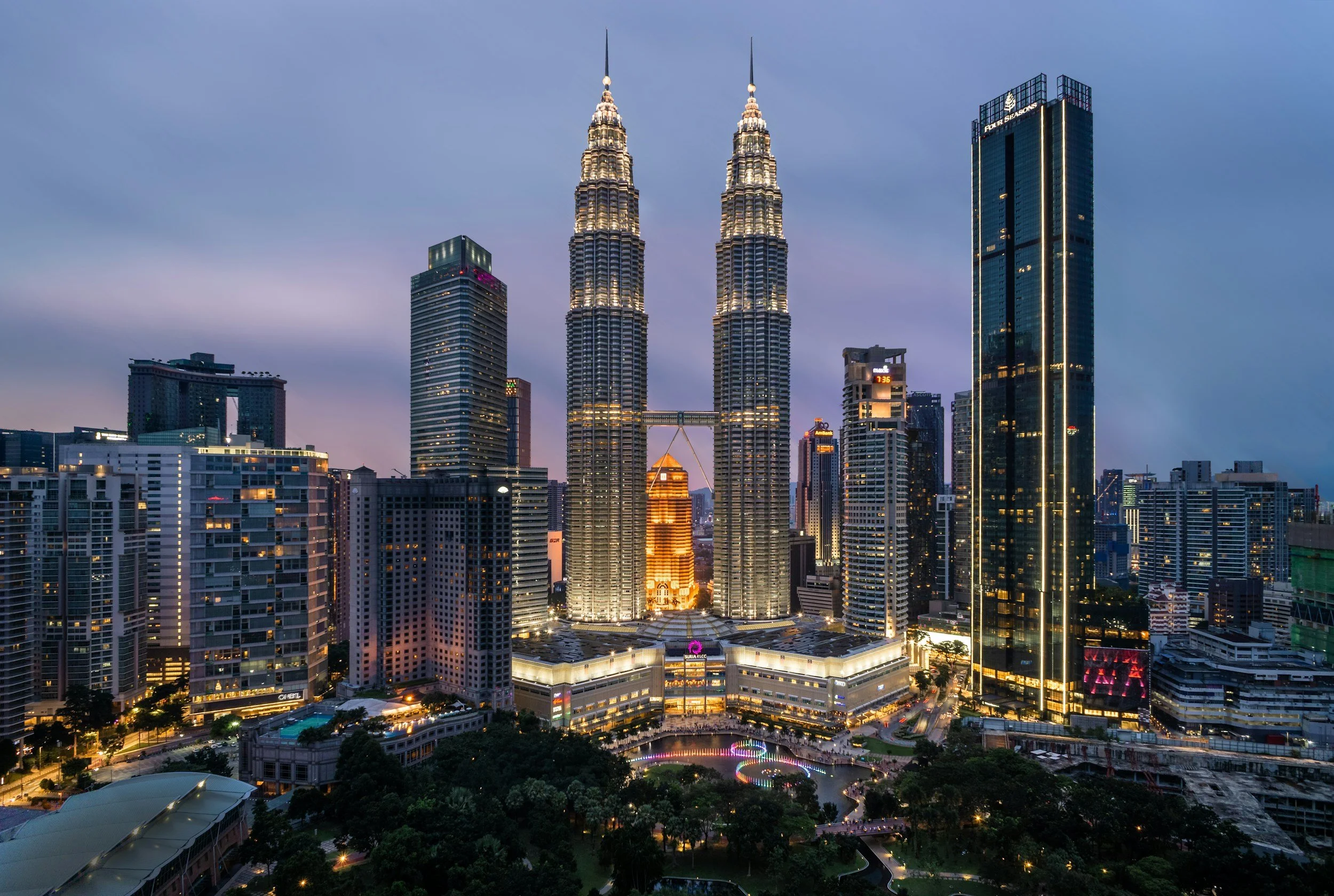
Kuala lumpur, Malaysia
While both Mainland China and Southeast Asia (SEA) emphasize the importance of relationships, the "how" and the "why" behind business interactions differ significantly. Navigating these regions requires shifting from a centralized, high-velocity mindset in China to a more fragmented, culturally nuanced approach in Southeast Asia.
1. The Relationship Dynamic: Guanxi vs. Connection
In both regions, a contract is often seen as the beginning of a relationship, not the final word. However, the structure of these relationships varies.
China (Guanxi): It is deeply reciprocal and hierarchical. It’s a system of "social credit" built over time through favors, shared meals, and mutual obligation. In business, Guanxi often flows toward the person with the most decision-making power.
Southeast Asia: Relationships are more about community and harmony. While hierarchy exists (especially in Thailand and Indonesia), there is a stronger emphasis on consensus. In SEA, being "liked" and fitting into the local social fabric is often as important as being "respected" for your position.
2. Communication Styles and "Face"
Both regions are high-context, meaning what isn't said is often more important than what is.
China: Communication is fast-paced but indirect when it comes to "No." A "Yes" might mean "I hear you," not "I agree." Saving "Face" (Mianzi) is paramount; criticizing a partner in front of their team can end a deal instantly. Deadlines are often hard stops.
Southeast Asia: The region is a mosaic. Singapore is relatively direct and Westernized. However, in countries like Malaysia or the Philippines, people may use "circular" communication to avoid conflict. There is a high tolerance for ambiguity, often referred to in some regions as "rubber time," where deadlines are viewed as flexible goals rather than hard stops.
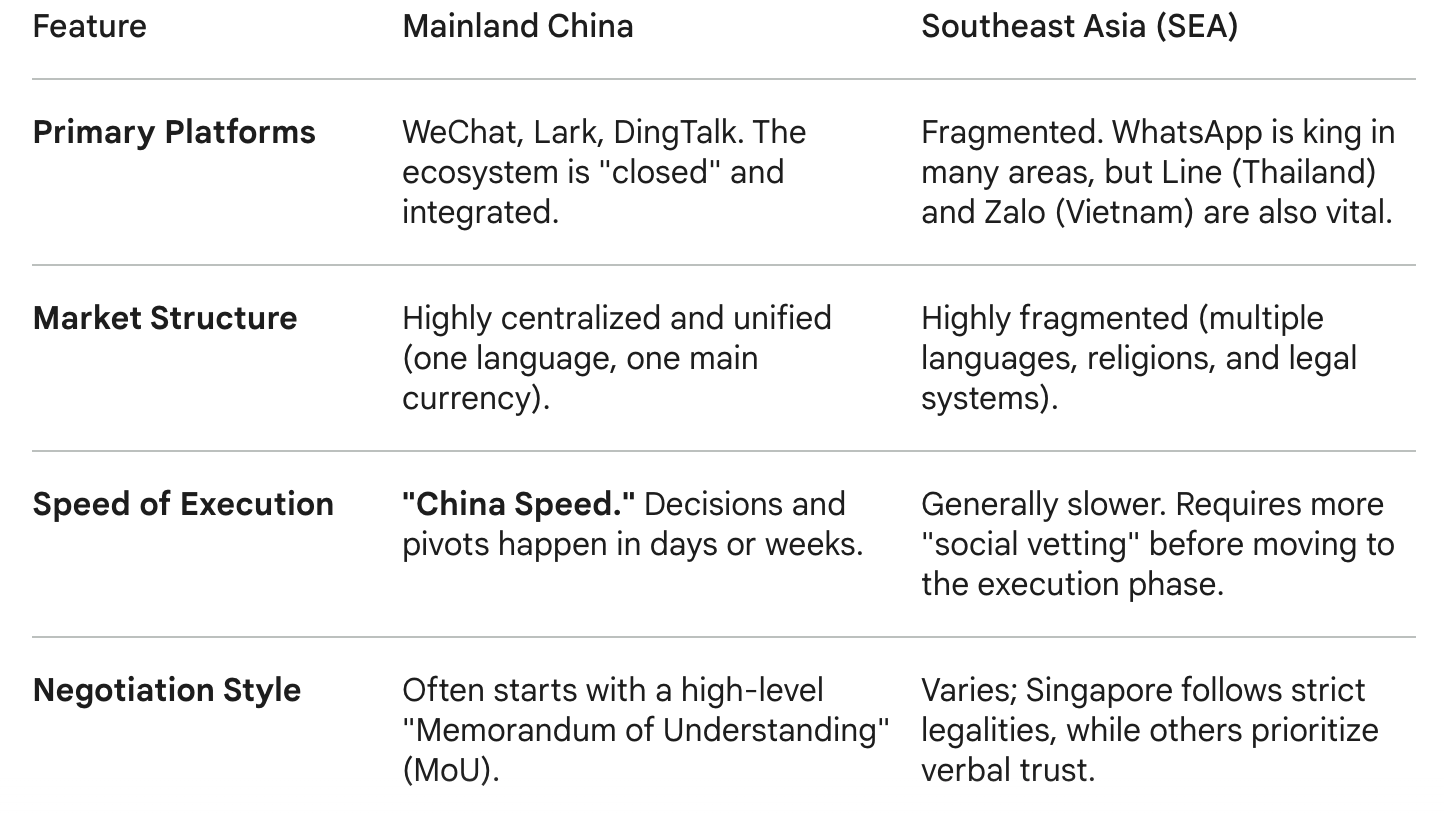
3. The Digital and Regulatory Landscape
The tools used to conduct business are perhaps the most visible difference between the two regions.
4. Religious and Cultural Nuances
While China is largely secular in business (with underlying Confucian values), Southeast Asia’s business calendar is dictated by diversity.
China: The Lunar New Year is the only major period where business completely halts. Other festivals would be the National Day, 11.11. to name a few.
SEA: You must account for Ramadan (Indonesia/Malaysia/Brunei), Songkran (Thailand), and Christmas (Philippines). Scheduling a high-stakes meeting during these periods can be seen as a lack of cultural awareness and respect.
Key Takeaway
If you are doing business in China, focus on alignment with the hierarchy and digital integration. If you are moving into Southeast Asia, focus on localized adaptability and patience. China is a sprint within a walled garden; Southeast Asia is a marathon across an archipelago. Hire a Chinese third party agency to help setup, management before expanding full scale to either China or Southeast Asia to prevent overspending on campaigns.
Successfully entering these two markets requires shifting from a "closed ecosystem" strategy (China) to a "fragmented, hyper-local" strategy (Malaysia and the broader SEA region).

Entering Mainland China: The Integrated Ecosystem Checklist
In China, digital and physical business are often inseparable. The goal is to move beyond simple localization and achieve full ecosystem integration.
Platform-Specific "Human Premium" Content: China’s algorithms on platforms like Xiaohongshu and Douyin prioritize high-frequency, authentic content. Static ads are less effective than "human-centric" storytelling that builds community trust before the sale.
Generative Engine Optimization (GEO) & SEO: While Baidu remains important, search behavior has shifted toward in-app search within WeChat and Xiaohongshu. Optimizing for AI-driven discovery and social search is now more critical than traditional keyword-heavy SEO.
The "Guanxi" Infrastructure: Beyond social connections, "Guanxi" in business now requires a local digital footprint. This means having a verified WeChat Official Account and, crucially, an ICP (Internet Content Provider) license to host your website on local servers to avoid the "Great Firewall" lag.
Closed-Loop Conversion: Western strategies often drive traffic to an external website. In China, the user journey must stay within the app (e.g., WeChat Mini-Programs). If a user has to leave an app to pay or sign a contract, you will see a massive drop in conversion.
Hyper-Speed Iteration: The Chinese market moves at "China Speed." Product cycles and marketing pivots are measured in weeks, not quarters. You must have a local team or partner empowered to make real-time decisions without waiting for headquarters' approval.
Entering Southeast Asia (Focus: Malaysia): The Mosaic Checklist
Malaysia is a gateway to SEA, but it requires a strategy that respects its multicultural and multi-platform nature.
The "WhatsApp First" Communication Strategy: In Malaysia, WhatsApp is the primary business tool. Unlike the formal email culture of the West or the WeChat ecosystem in China, business in Malaysia happens in chat threads. Responsiveness and a "personal touch" in messaging are key to closing deals.
Cultural and Religious Sensitivity (Halal & Holidays): Malaysia is a Muslim-majority country with significant Chinese and Indian populations. A successful entry requires navigating the Halal ecosystem (for F&B or cosmetics) and respecting a diverse calendar that includes Ramadan, Lunar New Year, and Deepavali.
Mobile-First Commerce Fragmentation: Unlike China’s dominance by a few giants, SEA is a battleground. Your strategy must account for Shopee, Lazada, and TikTok Shop, along with super-apps like Grab for logistics and payments.
Localized Multilingualism: While English is widely used in Malaysian business, marketing that incorporates Bahasa Melayu or Mandarin creates a deeper emotional connection with specific demographics. Localization here is not just about translation, but about cultural nuance.
Patience in Relationship Building: While China is about speed, Malaysia often requires a slower "vetting" period. Business is built on mutual respect and face-to-face (or video-to-video) rapport. Aggressive, "hard-sell" tactics can often backfire.
Whether you’re eyeing the high-velocity, integrated "walled garden" of Mainland China or the diverse, relationship-driven mosaic of Southeast Asia, one truth remains: there is no universal "best" market—only the one that best fits your current scale and strategic goals.
Entering these regions isn't just about translation; it's about transcreation. It’s the difference between simply being present and being culturally resonant. In an era of automated noise and AI-driven discovery, the "Human Premium"—the ability to build genuine trust and navigate local nuance—is your most valuable asset.
Your Bridge to the East: Bright Design Studio
Navigating the friction of new market entry requires more than a playbook; it requires a partner who lives and breathes these digital ecosystems. Bright Design Studio specializes in bridging the gap between global ambition and local impact.
Our team provides the localized expertise needed to turn complexity into a competitive advantage:
Strategic Market Entry: We handle the technical and regulatory "heavy lifting," from local licensing to ecosystem setup.
Comprehensive Management: We take the reins of your daily operations, ensuring your brand remains agile in the face of "China Speed" or "SEA Diversity."
Future-Ready Strategy: We move beyond traditional metrics, utilizing Generative Engine Optimization (GEO) and high-authenticity content to ensure your brand isn't just seen—it's sought after.
Don't leave your expansion to chance. Write to us hello123@brightdesignstudio.net
References:
https://www.china-briefing.com/doing-business-guide/china
https://www.mida.gov.my/invest-in-malaysia/setting-up-business/
https://reab.pro/en/info/business-traditions-and-mentality/malaysian-business-culture
https://culturalatlas.sbs.com.au/malaysian-culture/malaysian-culture-business-culture
https://www.aseanbriefing.com/doing-business-guide/singapore/why-singapore