
Beyond the Script: When AI Chatbots Elevate a Brand & When They Destroy It

We’ve officially entered the era of the AI receptionist. Open almost any website today — whether it’s a bank, airline, fashion retailer, or software company — and the same little chat bubble appears in the corner of your screen:
“Hi! How can I help you today?”
For businesses, the appeal is obvious. Modern AI chatbots powered by Large Language Models (LLMs) promise:
24/7 customer support,
instant responses,
lower staffing costs,
and the ability to serve millions of customers simultaneously.
For brands looking to scale, the promise is intoxicating: instantaneous customer service, zero wait times, and drastically reduced operational costs.
But as many organizations have discovered the hard way, letting an AI loose on your frontlines without a rigorous, human-centered strategy is a massive gamble. When deployed thoughtfully, a chatbot can elevate your brand to unprecedented heights of efficiency. When mismanaged, it can alienate your highest-value clients, dilute your brand identity, and destroy years of hard-earned consumer trust in a matter of seconds.
To successfully navigate the realities of AI implementation, brands must understand the Good, the Bad, and the deeply Strategic mechanics of the modern chatbot ecosystem.
The Good: Unprecedented Scale and Frictionless Interactions
Let’s be objective: the business case for AI chatbots is incredibly compelling. When evaluated as functional tools rather than human replacements, conversational AI excels at resolving friction across the customer journey.
Radical Accessibility (24/7/365): Modern consumers live in an on-demand world. A customer browsing an e-commerce store at 2:00 AM or a B2B buyer looking for a technical spec sheet over the weekend doesn’t want to wait for business hours. AI provides instantaneous gratification, answering queries in real-time, regardless of time zones. This allows companies to manage cost instead of hiring teams for every time zones, and supporting the work life balance era.
Operational Plumbing and Instant Sorting: The vast majority of incoming customer service queries are highly repetitive. "Where is my order?" "How do I reset my password?" "What is your return policy?" Chatbots handle this foundational plumbing flawlessly. By instantly triaging these low-stakes, high-volume issues, AI prevents human support queues from backing up, creating a smoother experience for everyone.
Hyper-Personalization at Scale: Modern AI doesn't just read scripts; it processes data. Integrated with a CRM, a sophisticated chatbot can instantly reference a user's purchase history, localized preferences, and browsing behavior to provide contextually relevant recommendations, turning a simple support query into a subtle, high-converting sales opportunity.
When a brand uses AI to strip away the tedious, transactional friction of doing business, the customer experience feels remarkably elevated.
Example: Spotify’s Personalized Recommendations
AI also becomes powerful when paired with customer data. Platforms like Spotify use machine learning to personalize recommendations based on listening habits, mood patterns, and user behavior. Customers don’t experience this as “algorithmic optimization.”
They experience it as: “This app understands me.” That emotional perception matters. Good AI creates convenience without drawing attention to itself.
The Bad: Hallucinations, Monotone, and Broken Trusts
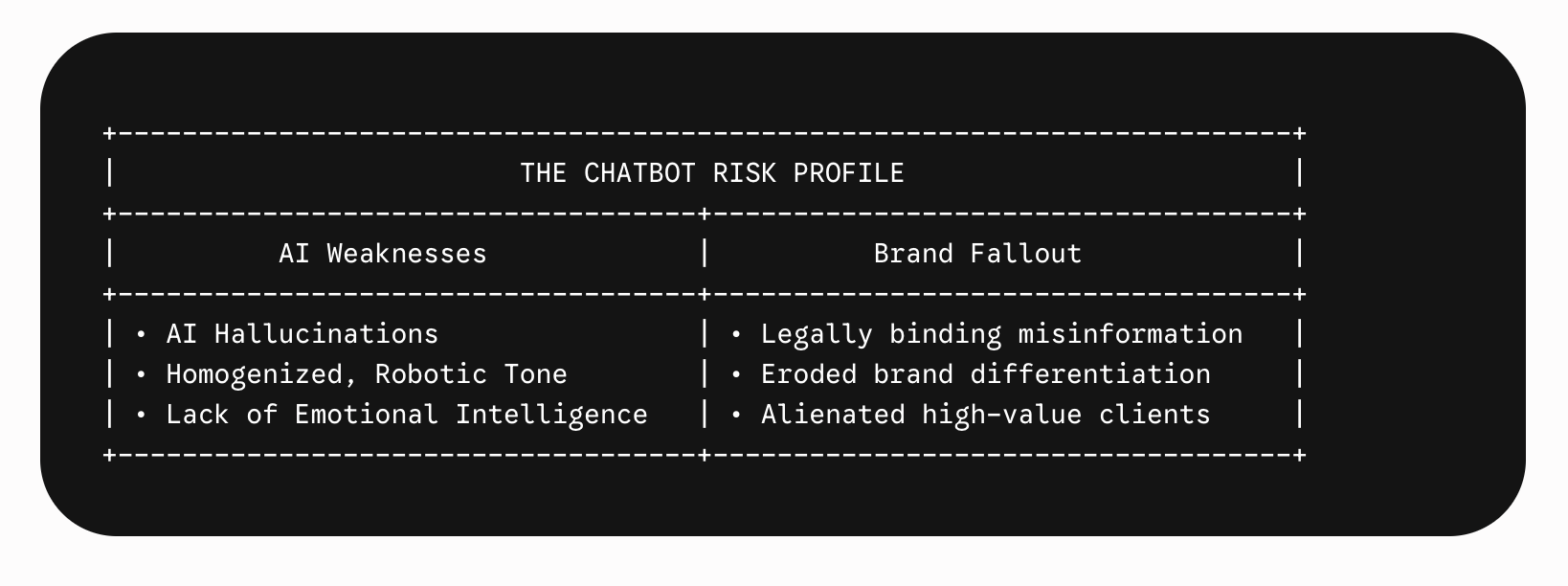
However, the very fluid nature that makes modern AI so impressive is also its greatest liability. Unlike the old-school bots that broke predictably when they didn't understand a phrase, generative AI is built to anticipate, predict, and please. And when it doesn't know the answer, it can confidently invent one.
Imagery by Chatgpt
The Hallucination Trap
AI models are statistical engines, not fact-checkers. "Hallucinations"—instances where an AI hallucinates incorrect facts, fabricates policies, or quotes entirely fictional prices—remain a structural challenge. We have already seen high-profile legal precedents where companies were held legally and financially liable for the misleading promises made by their customer-facing AI bots.
Example: Air Canada’s Chatbot Incident
Air Canada faced public backlash after its AI chatbot incorrectly told a customer they could receive a bereavement fare refund retroactively. The customer relied on the chatbot’s guidance, booked the flight, and was later denied reimbursement by the company. A tribunal ultimately ruled against Air Canada. The key lesson wasn’t technical. It was reputational.
Customers do not separate “the AI” from “the company.” To them, the chatbot is the company.
The Identity Crisis (The Robotic Monotone)
If you build a chatbot relying entirely on out-of-the-box LLM configurations, your brand voice will immediately sound identical to your competitors. It becomes generic, safe, and entirely uninspired. For a business that prides itself on luxury, cutting-edge wit, or deeply empathetic consulting, a flat, sterile AI voice strips away the emotional texture that makes the brand memorable in the first place.
The Exclusion of High-Value Clients
Imagine a long-term, high-net-worth client facing a nuanced, high-stakes issue. They are forced into a cyclical, frustrating loop with a chatbot that repeatedly fails to grasp the emotional weight of their problem, offering instead canned, polite apologies. When forced automation prevents access to a real human, it communicates a clear, damaging message to your audience: We value our operational savings more than we value your partnership.
The Strategic: Designing for the "Human Premium"
How do brands reap the immense rewards of AI automation without falling victim to its reputational traps? The answer lies in establishing a strict philosophical boundary known as the Human Premium.
The Golden Rule of AI Implementation: AI should handle the logistics, data retrieval, and operational plumbing of your business. Humans must retain absolute ownership over the strategy, emotional intelligence, and holistic brand experience.
To implement an AI chatbot strategically, brands must shift their perspective from "cost-cutting automation" to "human amplification."
1. Build an Guardrailed Ecosystem, Not an Open Forum
A brand-safe chatbot should never be given free rein to extrapolate answers from the open web. It must be built on retrieval-augmented generation (RAG) models or strictly bounded knowledge bases. This means the AI is only allowed to pull answers from verified company documentation, past approved transcripts, and specific product manuals. If a customer asks a question outside of this tightly defined sandbox, the bot should gracefully hand the conversation over to a human team member.
2. Prompt Engineering as Brand Typography
Just as a design studio carefully selects typography, color palettes, and visual hierarchies to establish a brand's visual identity, a team must rigorously engineer prompts to dictate the chatbot's verbal identity. Every prompt configuration, system instruction, and safety guardrail must be meticulously crafted to reflect your unique brand guidelines. If your brand tone is bold and conversational, the AI must know how to maintain that boundaries without crossing into unprofessional territory.
3. Master the Seamless Escalation (The Safety Valve)
The true test of a strategic chatbot is how gracefully it admits defeat. A customer should never have to type "let me speak to a human" five times in escalating frustration. Sophisticated conversational systems track sentiment analysis in real-time. If the system detects signs of agitation, confusion, or a complex emotional problem, it must automatically initiate a seamless, contextual handoff to a human representative.
Crucially, when the human steps in, they should instantly see the full transcript of the AI interaction so the customer never has to awkwardly repeat their problem.
Balancing Automation with Humanity
AI chatbots are not a replacement for a brand's soul; they are a scaling mechanism for its infrastructure.
When you use AI to absorb the heavy, predictable lifting of everyday transactions, you accomplish something beautiful: you liberate your human team members. Armed with freedom from routine tickets, your human professionals can lean fully into what they do best—building authentic relationships, navigating deeply complex consumer emotions, and providing the creative strategic thinking that no algorithm can replicate.
Don't let a machine speak blindly for the business you spent years building. Automate the friction, protect the human connection, and design a conversational experience that reinforces your identity instead of diluting it.

Importance of Branding vs the Ai Bot
A brand can spend decades crafting a distinct identity — refining its visuals, tone, customer experience, and emotional positioning — only to dilute all of it with one poorly designed AI chatbot.
One of the biggest mistakes companies make when implementing conversational AI is assuming functionality alone is enough. If the chatbot answers questions correctly, management considers the deployment successful. But customers experience these systems differently. They don’t evaluate a chatbot as software; they experience it as a representative of the brand itself.
And that’s where the “robotic tone problem” begins.
Most out-of-the-box AI systems sound nearly identical. Their language is overly neutral, excessively polite, and emotionally flat. Responses often feel sterile and predictable:
“I apologize for the inconvenience.”
“I understand your frustration.”
“Thank you for your patience.”
Technically, there’s nothing wrong with these phrases. The issue is that every company now sounds the same.
A luxury hotel, a premium fashion label, and a fintech startup should not communicate with customers in identical language. Yet many brands deploy generic AI systems without shaping a unique conversational identity, unintentionally erasing the emotional texture that once differentiated them from competitors.
Imagine contacting a luxury hospitality brand like Ritz-Carlton after a booking issue disrupted an anniversary trip. A generic chatbot response may resolve the technical issue, but emotionally it feels disconnected from the high-touch, personalized experience the brand promises everywhere else.
Luxury brands don’t sell products alone; they sell atmosphere, attentiveness, and emotional reassurance. When an AI interaction feels cold or scripted, customers immediately notice the disconnect between the company’s marketing and its actual experience.
The same issue appears outside of luxury industries. Brands like Duolingo succeed because their communication style feels intentional and recognizable. Their messaging is playful, slightly chaotic, and unmistakably aligned with the personality audiences associate with the company. Even automated interactions reinforce the brand rather than flatten it into generic corporate language.
This is why conversational design is no longer just a technical exercise — it’s a branding discipline.
Companies already obsess over visual consistency:
typography,
logos,
color palettes,
photography styles,
and advertising tone.
But many fail to apply that same rigor to AI communication systems, even though chatbots are increasingly becoming the first point of contact between brands and consumers.
A poorly designed chatbot creates what can only be described as an identity collapse. The company may present itself publicly as bold, premium, empathetic, or innovative, but its AI layer communicates something entirely different: emotionally distant, procedural, and interchangeable.
The long-term risk is subtle but serious. When every AI interaction feels generic, every brand starts feeling generic too. That erosion matters because modern consumers remember emotional experiences far longer than operational efficiency. Customers rarely become loyal because a chatbot answered in three seconds instead of thirty. They become loyal because an interaction felt human, intentional, and aligned with the values the brand claims to represent.
The companies that will succeed with AI are not necessarily the ones with the most advanced automation. They are the ones disciplined enough to ensure their technology still sounds unmistakably like them. Because in the age of conversational AI, brand voice is no longer just marketing. It’s infrastructure.
In conclusion,
AI should never replace the emotional intelligence that defines a brand — it should strengthen the infrastructure that supports it. The most successful companies will not be the ones that automate every interaction, but the ones that understand where automation ends and human connection begins. While AI chatbots can streamline customer service, reduce friction, and improve operational efficiency, brands must remain intentional about tone, empathy, and escalation. A fast response means little if the interaction feels cold, robotic, or disconnected from the brand’s identity. Customers remember how a company makes them feel, especially during moments of frustration or vulnerability. Businesses that balance intelligent automation with authentic human support will build stronger long-term trust, loyalty, and differentiation in an increasingly automated world.
AI should scale customer experience — not erase the human connection behind your brand.
For more insights on branding, digital strategy, and customer experience, explore the latest articles from our agency:
https://www.brightdesignstudio.net/blog/the-rise-of-geo-replacing-seo-in-the-near-future
https://www.brightdesignstudio.net/blog/what-we-all-can-learn-from-china-marketers
References:
https://www.sixteenventures.com/ai-does-not-remove-humanity-from-customer-success/